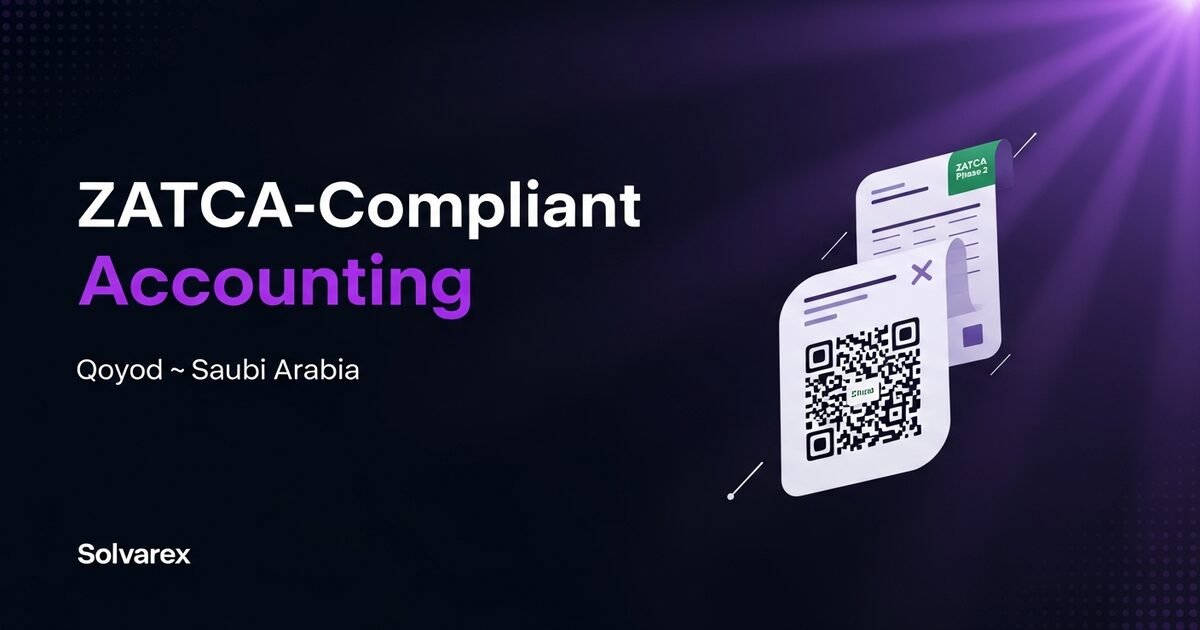
Saudi Arabia's business environment has transformed dramatically in recent years. Vision 2030 has accelerated digitization across every sector. Foreign companies are entering the market. Local SMEs are scaling regionally. New regulatory frameworks now govern how businesses operate, invoice, and report — and at the heart of this transformation sits one critical mandate: ZATCA e-invoicing compliance.
For Saudi businesses, this is no longer optional. The Zakat, Tax and Customs Authority (ZATCA) requires all VAT-registered businesses to issue, transmit, and store invoices through compliant electronic systems. The penalties for non-compliance are real. The technical requirements are specific. And generic accounting software — the kind designed for the United States or Europe — simply does not handle Saudi compliance natively.
This is exactly why Qoyod exists.
This guide explains what Qoyod is, why it has become the leading accounting platform for Saudi businesses, and how thousands of Saudi SMEs are using it to handle accounting, e-invoicing, payroll, and inventory in one Arabic-first cloud system. As implementation specialists at Solvarex, we have rolled out Qoyod across dozens of Saudi businesses ranging from family SMEs to fast-growing tech startups. Here is everything you need to know.
What is Qoyod?
Qoyod is a cloud-based accounting and business management platform designed specifically for the Saudi Arabian market. Founded in Riyadh and built by a team that understands Saudi business operations, regulatory requirements, and Arabic-language usage, Qoyod has become the platform of choice for thousands of small and medium-sized businesses across the Kingdom.
Unlike global accounting platforms that adapt their products to work in Saudi Arabia, Qoyod was built from day one for Saudi businesses. ZATCA compliance is not a plugin — it is core architecture. Arabic is not a translation layer — it is the native interface. Saudi accounting standards, VAT calculations, GOSI integration, and the Saudi business calendar are all built into the platform's foundation.
The result is an accounting system that finally fits how Saudi businesses actually operate.
Why Qoyod Matters for Saudi Businesses in 2025
The accounting software market in Saudi Arabia has shifted dramatically. A few years ago, businesses chose between using global platforms like QuickBooks (with painful Arabic adaptation) or relying on legacy desktop software with limited capabilities. That era is over.
Today, Saudi businesses face very specific challenges that only locally-built solutions can address:
ZATCA Phase 2 e-invoicing compliance requires invoices to be generated, signed cryptographically, and reported to ZATCA's Fatoora platform in real time. This is not something most global accounting tools handle natively.
Arabic-first operations are non-negotiable for businesses serving Saudi customers. Invoices, statements, contracts, and reports all need to be Arabic by default.
VAT calculation specific to Saudi rules including the 15% rate, exemption categories, and reverse charge mechanisms.
Integration with Saudi banking and payment systems including SADAD, mada, and local payment gateways.
GOSI and labor compliance for businesses with Saudi and expat employees.
Local customer support in Arabic during Saudi business hours.
Qoyod handles all of these natively. There is no adaptation, no workarounds, no third-party plugins. The system was designed for this market — and it shows.
For more on Saudi-specific compliance requirements, see our complete guide on ZATCA e-invoicing compliance for Saudi businesses.
The Core Capabilities of Qoyod
Let's break down what Qoyod actually does and why each capability matters for Saudi businesses.
1. ZATCA-Compliant E-Invoicing
This is the anchor capability. Qoyod is fully integrated with ZATCA's Fatoora platform and handles every aspect of Phase 2 e-invoicing compliance:
- Real-time invoice clearance with ZATCA before delivery to customers
- Cryptographic signing of all tax invoices
- QR code generation matching ZATCA specifications
- UUID generation for each invoice
- Standard tax invoices for B2B transactions
- Simplified tax invoices for B2C transactions
- Credit and debit note handling per ZATCA requirements
- Invoice archiving for the required retention period
For Saudi businesses, this single capability eliminates an entire category of compliance risk. You issue invoices through Qoyod's normal interface, and ZATCA compliance happens automatically in the background.
2. Bilingual Arabic and English Operations
Most Saudi businesses operate in both Arabic and English. Customer invoices may need to be in Arabic. Reports for international stakeholders may need to be in English. Internal records may use either or both.
Qoyod handles this natively. Every document, report, and invoice can be generated in Arabic, English, or both languages side by side. The interface itself runs fully in Arabic with proper right-to-left support — not as a translation overlay but as a native experience.
For Saudi businesses serving multinational clients or operating across the GCC, this bilingual capability is essential.
3. VAT Management Built for Saudi Rules
Saudi VAT has specific rules that differ from VAT systems elsewhere. Qoyod handles all of them:
- Standard 15% VAT calculation on applicable transactions
- Zero-rated and exempt categories automatically classified
- Reverse charge mechanism for cross-border services
- VAT return preparation in ZATCA-required format
- Quarterly VAT submissions with one-click reporting
- Input VAT recovery tracking and reconciliation
Businesses that previously spent days preparing each quarterly VAT return now complete it in hours with Qoyod.
4. Inventory and Stock Management
Qoyod includes a full inventory management module — a critical capability for retail, wholesale, and distribution businesses across Saudi Arabia:
- Multi-location inventory for businesses with multiple branches or warehouses
- Stock level alerts when items run low
- Purchase order management with supplier tracking
- Cost tracking and valuation using FIFO or weighted average
- Barcode and SKU support for inventory operations
- Real-time stock visibility integrated with sales and procurement
For SMEs trying to manage operations across spreadsheets and disconnected systems, this integration alone justifies the move to Qoyod.
5. Payroll and Employee Management
Qoyod includes Saudi-specific payroll capabilities that handle the unique requirements of operating in the Kingdom:
- Saudi labor law compliance built into payroll calculations
- GOSI contribution calculations for Saudi employees
- End-of-service benefit tracking for expat employees
- Allowance and deduction management matching Saudi norms
- Salary slip generation in Arabic and English
- Bank file generation for salary transfers through Saudi banks
For HR-heavy businesses or those managing multiple employee categories, having payroll integrated with accounting eliminates entire categories of reconciliation errors. For specialized HR-focused capabilities, businesses sometimes pair Qoyod with a tool like Deel for international hiring or Gusto for additional payroll automation.
6. Banking and Reconciliation
Qoyod connects with Saudi banks for automated transaction import and reconciliation:
- Bank feed integration with major Saudi banks
- Automatic transaction matching against invoices and bills
- Multi-currency support for businesses dealing internationally
- Cash flow forecasting based on actual banking data
- Reconciliation workflows that flag discrepancies for review
The result is books that close faster, with fewer errors, and with much less manual data entry.
7. Reporting and Business Intelligence
Qoyod provides comprehensive financial reporting designed for Saudi business needs:
- Income statements and balance sheets in Arabic and English
- Cash flow statements with multi-period comparisons
- VAT reports in ZATCA-required format
- Departmental reporting for businesses with multiple cost centers
- Custom dashboards for management reviews
- Audit trail for compliance reviews
For businesses preparing for investor due diligence, bank loan applications, or regulatory audits, having Qoyod's reporting infrastructure available cuts preparation time from weeks to days.
Who Should Use Qoyod?
Like any platform, Qoyod fits some businesses better than others. Understanding the ideal use case helps you decide.
Qoyod is ideal for:
Saudi-registered businesses of any size that need ZATCA-compliant accounting. This is the core use case — and Qoyod is hard to beat in this category.
Arabic-first or bilingual operations where invoices, reports, and records need to be in Arabic.
SMEs scaling beyond spreadsheets that need a real accounting system but want to avoid the complexity of enterprise platforms.
Retail and wholesale businesses that need integrated inventory management alongside accounting.
Service businesses with subscription billing, recurring invoices, or project-based revenue tracking.
Companies preparing for funding or audit that need clean, professional financial reporting.
Saudi tech startups that want financial infrastructure that scales with their growth.
Qoyod may not be ideal for:
- Businesses operating exclusively outside Saudi Arabia and the GCC
- Very large enterprises with complex multi-entity, multi-country accounting needs
- Pure US-focused operations where QuickBooks integration with US-specific services is essential
For 95% of businesses operating in Saudi Arabia, however, Qoyod is the right choice.
How Solvarex Implements Qoyod for Saudi Businesses
Buying Qoyod is straightforward. Migrating your existing accounting data, configuring the platform for your specific business, training your team, and ensuring full ZATCA compliance — that requires expertise.
This is where Solvarex helps. As experienced ERP and accounting implementation specialists, our typical Qoyod implementation includes:
- Discovery and current state analysis — understanding your existing accounting setup
- Chart of accounts design matched to your business type and Saudi reporting needs
- Data migration from your existing system (Excel, QuickBooks, legacy software)
- ZATCA configuration with proper certificate setup and Fatoora integration
- VAT setup for your specific business categories
- User and role configuration with proper access controls
- Bank feed setup for your Saudi banking accounts
- Inventory and product catalog setup if applicable
- Payroll configuration if HR is included in scope
- Team training in Arabic or English
- Post-launch support for the first 90 days
We have implemented Qoyod for clients across Riyadh, Jeddah, Dammam, and the broader Saudi market — including retail businesses, professional service firms, e-commerce operations, and tech startups. Each implementation is tailored to the specific industry requirements.
If you are evaluating Qoyod or planning a migration from your current system, book a free consultation and we will scope your specific situation.
Qoyod Pricing in Context
Qoyod operates on a subscription model with several tiers based on the size of your business and the modules you need. The pricing is positioned for Saudi SMEs — significantly lower than enterprise platforms while delivering the full feature set most businesses need.
What makes Qoyod's pricing especially attractive is what it includes natively:
- ZATCA compliance included (not a separate add-on)
- Arabic interface and reporting included
- Multi-user access based on tier
- Saudi-based customer support included
- Regular updates for regulatory changes
Compare this to running a global accounting platform plus separate ZATCA compliance software plus separate Arabic translation services — and the math becomes very clear.
Try Qoyod free → to evaluate the platform with your own business data.
Qoyod in Your Broader Business Stack
Qoyod sits at the financial center of a Saudi business stack. The architecture we recommend looks like this:
Sales and pipeline: Pipedrive for managing deals through the sales process
Lead generation: Apollo.io for B2B prospecting and outbound
Email marketing: Brevo for nurturing customers and prospects
Accounting and invoicing: Qoyod for financial operations and ZATCA compliance
HR and payroll for international hires: Deel
HR for Saudi-domiciled employees: Qoyod's built-in payroll module
This stack handles every operational need of a growing B2B business in Saudi Arabia, from first prospect contact to closed deal to invoiced revenue to compliant reporting. We described this complete architecture in our GTM strategy guide for Saudi B2B startups.
Common Questions About Qoyod
Is Qoyod ZATCA Phase 2 compliant?
Yes. Qoyod is fully compliant with ZATCA Phase 2 (Integration Phase) e-invoicing requirements, including real-time invoice clearance with the Fatoora platform.
Does Qoyod work entirely in Arabic?
Yes. Qoyod's interface, invoices, reports, and customer support are fully available in Arabic. The platform also supports English and bilingual document generation.
Can Qoyod handle businesses with multiple branches?
Yes. Qoyod supports multi-branch operations including separate branch accounting, consolidated reporting, and inter-branch transactions.
How does Qoyod handle VAT?
Qoyod automates Saudi VAT calculations including standard rate, zero-rated and exempt categories, and reverse charge for cross-border services. Quarterly VAT returns can be generated and submitted directly to ZATCA.
Can I migrate from QuickBooks or other software to Qoyod?
Yes. Qoyod supports data migration from common accounting systems. Solvarex's implementation service handles this migration including chart of accounts mapping, opening balance entry, and historical transaction import.
Does Qoyod include payroll?
Yes. Qoyod's payroll module handles Saudi-specific requirements including GOSI calculations, end-of-service benefits, and bank file generation for salary transfers.
Is my data secure with Qoyod?
Yes. Qoyod operates on enterprise-grade cloud infrastructure with encryption, regular backups, and access controls. The platform meets Saudi data protection requirements.
Does Qoyod integrate with other business tools?
Yes. Qoyod offers integrations with common business tools and an API for custom integrations. Common integrations include CRM systems, e-commerce platforms, and banking systems.
Getting Started with Qoyod
The simplest way to evaluate Qoyod is to start with a free trial and explore the platform with your own business data. There is no commitment, and you can see whether the interface, features, and Arabic experience match your team's needs.
If you want to ensure proper setup, ZATCA compliance, data migration, and team training without the trial-and-error phase, our ERP Implementation service handles end-to-end Qoyod deployment.
To discuss whether Qoyod is the right accounting platform for your Saudi business, book a free 30-minute consultation. We will review your current accounting setup, business size, compliance requirements, and integration needs — and give you a clear recommendation.
Final Thoughts
For Saudi businesses, the accounting platform decision is no longer about features alone. It is about regulatory fit, language fit, and operational fit. Generic global platforms can be made to work — at significant cost and complexity. Locally-built platforms that understand the Saudi market deliver more value with far less friction.
Qoyod is the leading example of this principle. Built for Saudi Arabia from day one, fully ZATCA-compliant, completely Arabic-capable, and priced for SMEs — it solves the accounting problem that growing Saudi businesses actually have.
If you are running your business on spreadsheets, legacy desktop software, or a non-compliant cloud platform, this is your invitation to look seriously at Qoyod.
For more on building a complete operational infrastructure for Saudi businesses, explore our guides on ZATCA e-invoicing compliance, HR software for UAE and Saudi Arabia, and GTM strategy for B2B startups in Saudi Arabia.
Or skip the research and book a consultation — we are happy to recommend the right accounting platform and complete operational stack for your specific situation.
Related Articles
Gusto: The Modern Payroll Platform Powering US-Registered Companies and Their MENA-Based Founders
For MENA founders operating US LLCs or C-Corps — and the growing number of Saudi and Emirati companies expanding into the US market — managing American payroll, benefits, and tax compliance has long been painful. Gusto solves this elegantly for 500,000+ businesses, and increasingly for MENA companies with US operations. Here's why Gusto matters and how to use it strategically.

Deel: The Global Hiring Platform Powering International Growth for MENA Companies
For ambitious companies in Saudi Arabia, UAE, and MENA, the talent you need rarely sits in the same city as your office. Deel solves this elegantly — letting you hire, pay, and manage talent in 150+ countries without setting up local entities. Trusted by 25,000+ companies globally, here's why Deel matters for MENA businesses scaling beyond borders.
Enjoy Your Summer — Let QuickBooks Online Keep Your US Business Finances in Order
Summer invites a slower pace — vacations, travel, and a well-earned breather. But for founders running US-registered entities, finances don't take a holiday. Bookkeeping, invoicing, and tax-readiness still need attention. The good news? QuickBooks Online lets you keep your financial house in order on autopilot — so you can soak up every moment of the season without falling behind.
Enjoyed this article? Get more insights in our LinkedIn newsletter.
Subscribe on LinkedInReady to implement this for your business?
Book a free 30-minute consultation with our team.